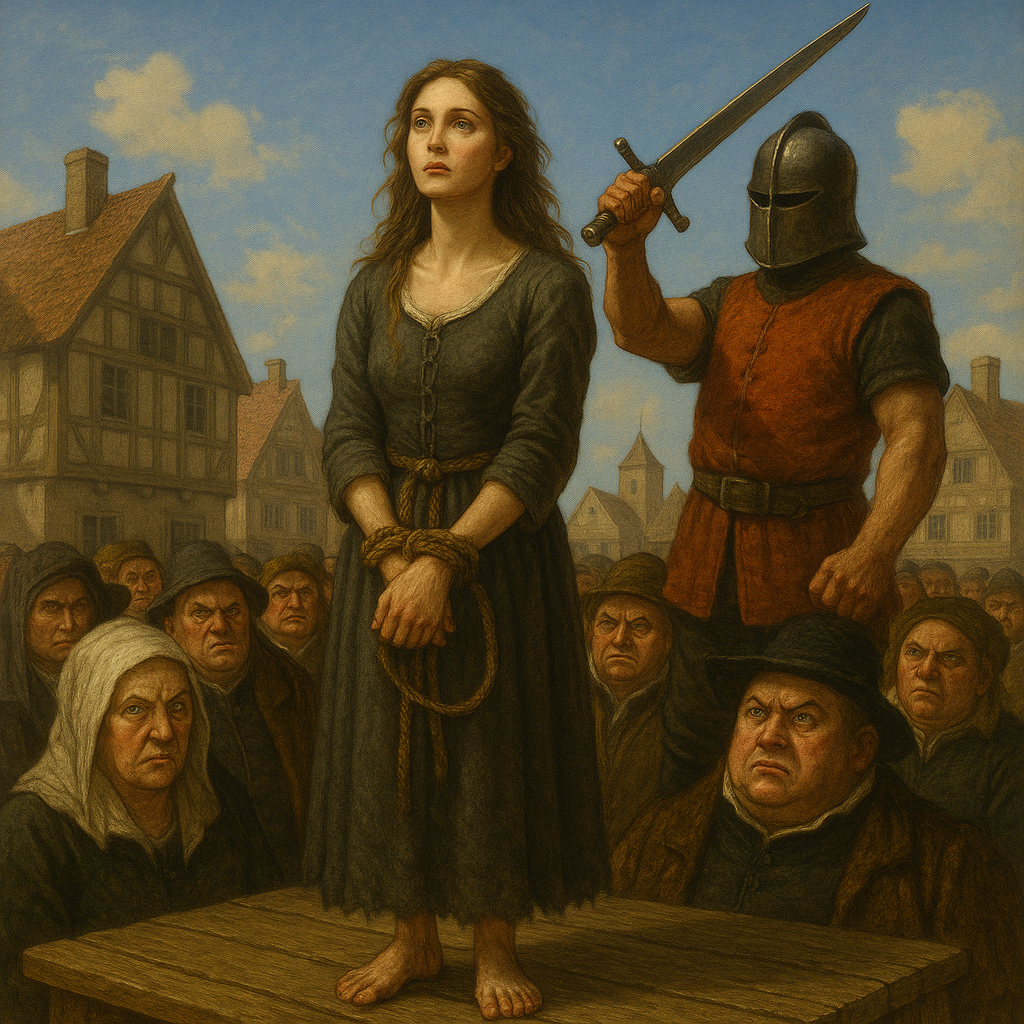
Historical Misconceptions
The history of the witch hunts is surrounded by surprisingly many misconceptions. One common misconception, for example, is that the standard punishment for witchcraft was burning at the stake. In reality, this was the punishment for heresy, under which witches were often prosecuted. In England and throughout the British colonies, for example, the punishment for witchcraft was hanging, not burning.
Another misconception is that only women were accused of witchcraft. Around 70 to 80 percent of the victims were women, but thousands of men and even children were also accused and executed. In some regions, men actually formed the majority of the victims. In Normandy, three out of every four executions were men, while in Moscow the proportion was roughly seven out of ten.
Across Europe, approximately 40,000 people were convicted and executed for witchcraft over several centuries. One of the last legal executions took place in Switzerland in 1782. Most victims were poor, and many were elderly women.
Outside Europe and the United States, the subject has received much less historical attention, although witch persecutions have continued into modern times. The earliest known recorded execution for witchcraft was that of Theoris of Lemnos in 323 BC. One of the most recent documented cases is that of Sangweni Jostina, who was killed in South Africa in 2021. The true number of victims throughout history is therefore almost certainly much higher than the European figures suggest. What made Europe unusual was not the belief in witches, but the scale on which witch persecutions became institutionalized.
A final misconception is that the witch hunts were primarily the work of the Catholic Church. In reality, only the Spanish Inquisition played a substantial role. Most witch trials were conducted by secular authorities rather than by the Church itself.
Cases Through the Centuries
One of the first women in England to be hanged for witchcraft after a formal trial was Agnes Waterhouse in 1566. She was a woman in her fifties from a small village who owned a cat named Satan. She was accused of making a fellow villager ill, killing livestock, and murdering her own husband through witchcraft. Agnes admitted killing the animals but denied ever harming people. However, a twelve-year-old neighbor claimed she had seen a black dog with the face of a monkey that demanded butter and threatened her with a knife. She then asked the dog who its master was, and the dog nodded toward Agnes’s house.[8]
Machteld ten Ham was a Dutch woman from ‘s-Heerenberg who was burned as a witch in 1605. The town had recently been plundered by the Spanish, and the plague was spreading. Machteld appears to have had some knowledge of medicine and tried to warn her fellow villagers about possible health risks. Soon afterwards, accusations of witchcraft began to circulate. She refused to be weighed on the famous witch scales in Oudewater because she regarded the practice as nonsense. Confident that her fellow townspeople would give her a fair trial, she saw no reason to prove her innocence by superstition. She was convicted of making animals sick, ruining harvests, and destroying marriages. She was tortured until she confessed and was then burned at the stake.
The last woman sentenced to death for witchcraft in Sweden was Anna Eriksdotter. She had worked as the local pastor’s housekeeper in a small village but was dismissed after rumors about her began to spread. One day, the pastor found seeds scattered on the road leading to the church, after which he suddenly lost the ability to speak properly. The rumor was that Anna had placed the seeds there in revenge for losing her job. Another accusation came from Nils Johansson, who claimed he had lost his speech after refusing to give Anna some tobacco. She confessed to everything and was sentenced to death by a local court in 1704, despite the Supreme Court asking the king to spare her because she was elderly and mentally confused.[9]
A final and much more recent example is that of Ama Hemmah from Ghana in 2010. On 20 November, the local pastor claimed to have seen her in his sister’s bedroom after the children had already left for school. He immediately gathered the villagers together. Ama was tortured until she confessed to being a witch and was then burned alive with kerosene so that she could be purified of evil. This time, the five people responsible for burning her alive were arrested. Nevertheless, accusations of witchcraft remain a widespread problem in Ghana. Women accused by their fellow villagers often have to flee to special “witch camps” because they would otherwise be murdered.[10]
The Lessons of the Witch Hunts
These stories all follow the same pattern. One of the villagers notices something unusual: a large black dog, someone saying things that others do not understand, seeds scattered on the path to the church, or an elderly woman becoming forgetful. What follows is always the same sequence of events. Someone starts a rumor. The rumor spreads. The villagers reinforce one another’s suspicions. Eventually they conspire to torture one of their own neighbours and burn them alive.
What makes these cases remarkable is that the accused were not strangers. They were people the villagers had grown up with, greeted in the street, spoken to for years, and sometimes even shared meals with. Yet gossip proved powerful enough to persuade ordinary people to burn one of their own neighbours alive.
The villagers are not searching for evidence to determine whether someone is a witch. They are searching for evidence that someone is a witch. The accusation does not emerge from the evidence; the accusation determines what counts as evidence. There is no genuine investigation, only an attempt to confirm what the rumor has already established as true. The question is no longer whether the accused is guilty, but how guilty they are. The verdict has already been reached. Everything that follows merely serves to justify it. Hatred comes afterwards, eventually becoming strong enough to persuade ordinary people to burn someone from their own community alive.
To be clear, the final case described above took place in Ghana in 2010. Witch persecutions are therefore not merely a relic of the Middle Ages. They continue into the present day. Recent cases from countries including Angola, Guinea-Bissau, and Mozambique demonstrate that accusations of witchcraft still lead to torture and death. It is therefore likely that many such killings continue to occur without ever being formally documented.
Popular Justice
The weak, the elderly, people suffering from depression or schizophrenia, or simply those who think differently; the community gossips about them, tortures them, and burns them alive without evidence or due process. This was still happening in 2021.
All of the cases above follow the same pattern. Someone stands apart from the group, behaves differently, and is killed. There is no opportunity to deny the accusation and say, “You’re mistaken. I’m not a witch.” Even when the accused admits to being a witch but denies ever harming anyone, there is no mercy. They are tortured, tied to a stake, and burned alive.
What is remarkable is that the people passing judgment have usually read very little, know almost nothing about previous trials, and possess no real knowledge of witchcraft itself. They are exceptionally poorly equipped to make such judgments. Yet they gossip, become convinced they know the truth, ask themselves why the rumor would exist if it were not true, reinforce one another’s beliefs, search only for confirmation, and finally take action.
It is the group against the individual. The accused is often someone who already stands outside the group and may also be elderly, poor, or suffering from mental illness. There is no compassion and no sense of guilt, only condemnation. There is no trial, no investigation, only torture and execution.
The villagers do not believe it is necessary to read, to reflect on the consequences of their actions, to hear the other side of the story, to consider the individual’s circumstances, or to look for evidence. Instead, they feel entitled not only to kill people who are slightly different, but also to torture them in order to justify their own delusions.
Nothing even has to happen. Once someone has been labelled a witch, that alone becomes sufficient to justify torture and death.
This is popular justice. There is no doubt, no real discussion, because nobody ever asks whether the accusation is true. The only possible outcome is condemnation, because no one is looking for evidence to the contrary. The community destroys those who fall outside the group, and even when the accusation later proves false, there is little sense of responsibility because no one feels personally accountable for the rumors spread by the group.
Modern Variants and the Rule of Law
In Europe we no longer burn witches. The mechanism, however, has not disappeared. It has merely found different targets. The labels have changed, but the process has remained remarkably similar.
The lesson of the witch hunts is not simply that innocent people became victims of mobs. The deeper lesson is that justice cannot be left to rumor.
The accusation did not emerge from the evidence.
The accusation determined what counted as evidence.
Once someone has been labelled a witch, the investigation is no longer about whether that person is a witch. It becomes a search for stories, coincidences, and testimonies that confirm what the community already “knows.” Evidence is no longer used to test the accusation; it is used to justify it.
The same danger exists whenever morally charged accusations replace objective investigation. Once a person is publicly labelled any form of social enemy, there is always the temptation to interpret every ambiguous fact through that label instead of first asking whether the accusation itself has been established.
Psychologists have argued that gossip strengthens social bonds. It creates shared meaning, reinforces group identity, and allows people to define themselves against a common enemy. That helps explain why gossip is so attractive. History also shows its danger. Once gossip becomes evidence, ordinary people can convince themselves that extraordinary punishments are acts of justice.
History suggests that this mechanism is not confined to one ideology, one religion, or one period of history. Whenever people become convinced that another person represents an intolerable evil, anger can replace fairness, accusation can replace investigation, and punishment can become more important than discovering the truth.
The rule of law exists because even intelligent, educated people are capable of abandoning fairness once they become morally convinced that another person deserves condemnation or even death. The purpose of the rule of law is not only to protect society from criminals, but also to protect individuals from the dangers of mob mentality.
History suggests that whenever a community stops asking whether an accusation is true and begins looking only for someone to condemn, justice has already been abandoned.
[1] HistoryExtra. “History of the Witch Trials: Were Witches Burned or Hanged?”
https://www.historyextra.com/period/tudor/history-witches-facts-burned-hanged
[2] Wikipedia. “Maleficium (Sorcery).”
https://en.wikipedia.org/wiki/Maleficium_(sorcery)
[3] Wikipedia. “Theoris of Lemnos.”
https://en.wikipedia.org/wiki/Theoris_of_Lemnos
[4] Wikipedia. “Anna Göldi.”
https://en.wikipedia.org/wiki/Anna_G%C3%B6ldi
[5] Wikipedia. “Agnes Waterhouse.”
https://en.wikipedia.org/wiki/Agnes_Waterhouse
[6] Wikipedia. “Anna Eriksdotter.”
https://en.wikipedia.org/wiki/Anna_Eriksdotter
[7] BBC News Magazine. “Ghana’s Witch Camps.”
https://www.bbc.com/news/magazine-19437130
[8] University of Münster. “Death by Ordeal: Witchcraft Accusations in Angola.”
